Executive Summary
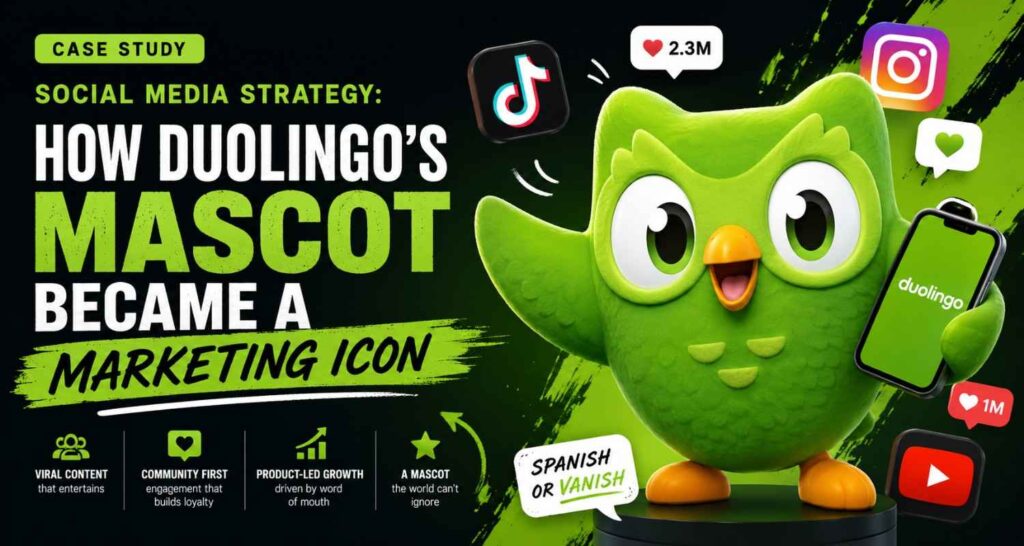
Most companies use social media to promote their products. Duolingo’s social media strategy does something different. It entertains people first and markets the product second.
That simple shift helped turn Duo, the company’s green owl mascot, into one of the internet’s most recognizable brand characters. Instead of publishing polished advertisements, Duolingo built a personality. The mascot jokes with celebrities, follows internet trends, joins viral conversations, and isn’t afraid to laugh at itself.
The result is a brand that people actively follow, even when they aren’t learning a language.
What’s even more interesting is that this approach supports Duolingo’s broader business strategy. The company states that most of its growth over the past decade has come through word of mouth, supported by a product-focused culture and continuous experimentation rather than heavy advertising.
This case study examines how Duolingo built a social media strategy around humor, community engagement, and a memorable mascot. It explores the decisions behind the brand’s online presence, the role of TikTok in its success, and the lessons marketers can apply to their own brands.
About Duolingo
The Company
Duolingo was founded in 2011 by Luis von Ahn and Severin Hacker with a simple mission: develop the best education in the world and make it universally available.
The company launched its language learning app in 2012 and has since grown into the world’s most popular language-learning platform. Over the years, it expanded beyond languages by introducing products such as the Duolingo English Test, Duolingo Math, Music, and Chess.
Unlike many education companies that rely on expensive courses or subscriptions from the start, Duolingo adopted a freemium model. Anyone can begin learning for free, while premium features are offered through paid subscriptions.
This approach helped the company reach millions of learners across different countries and age groups while maintaining its mission of making education accessible.
Duolingo's Growth Philosophy
One of the biggest reasons Duolingo stands out is its approach to growth.
The company openly states that the majority of its growth has come through word of mouth. Instead of depending heavily on paid advertising, Duolingo invests in improving the product, running thousands of experiments, and creating an experience that people naturally recommend to others.
This mindset extends beyond the app itself.
Its social media channels aren’t designed to push constant sales messages. They’re built to strengthen the brand, keep people talking, and create moments worth sharing.
Every viral video, trending meme, or humorous interaction increases brand awareness. Even people who have never downloaded the app often recognize Duo the Owl.
That level of recognition is difficult to achieve through traditional advertising alone.
The Language Learning Market Before Duolingo
A Serious Industry
Before Duolingo entered the market, language learning products followed a familiar formula.
Most focused on textbooks, classroom instruction, audio lessons, or expensive software. Their marketing highlighted grammar rules, vocabulary lists, certifications, and academic success.
While these products helped people learn, very few built memorable brands.
Their websites, advertisements, and social media accounts usually looked professional but predictable. Educational companies rarely became part of internet culture or everyday online conversations.
For younger audiences especially, language learning often felt like another school subject rather than an enjoyable daily habit.
This created an opportunity for a company willing to present education differently.
Sources: Duolingo About; Wikipedia – Duolingo.
A Different Way to Build an Education Brand
Duolingo didn’t just redesign language learning. It redesigned how an education company could communicate online.
Instead of presenting itself as a strict teacher, the brand adopted a playful personality. Lessons became short, colorful, and game-like. Progress was rewarded with streaks, badges, and achievements.
The same thinking eventually appeared on social media.
Rather than producing polished promotional videos, Duolingo created content that felt native to each platform. It embraced jokes, trends, memes, and conversations already happening online.
This made the company feel less like an education business and more like an internet personality.
That change became the foundation of one of the most successful social media strategies in recent years.
Why Social Media Became Duolingo's Biggest Marketing Channel
Marketing Beyond Advertising
Many brands use social media as another place to display advertisements.
Duolingo took a different approach.
Instead of asking, “How do we sell our product?” the company asked, “How do we create content people actually want to watch?”
That shift changed everything.
Most Duolingo videos don’t begin with product features or subscription offers. They start with humor, unexpected situations, or trending internet jokes. The product often appears naturally within the content rather than becoming the entire message.
This entertainment-first approach helped Duolingo reach audiences that traditional advertising would have struggled to engage.
Every viral post introduced the brand to millions of potential users without feeling like an advertisement.
Brand Awareness Before Conversions
Modern marketers often focus on immediate conversions.
Duolingo understood that social media plays a different role.
By making people laugh, encouraging comments, and participating in online culture, the company built familiarity long before asking anyone to download the app.
Former Senior Global Social Media Manager Zaria Parvez has explained that building brand awareness came before measuring direct return on investment. That philosophy helped Duolingo become one of the most talked-about brands on platforms like TikTok.
People who repeatedly saw Duo on their feeds eventually remembered the brand when they decided to learn a language.
The social media strategy wasn’t replacing the product. It was making sure people thought about Duolingo before its competitors.
The Birth of Duo the Owl
More Than a Mascot
Many companies have mascots.
Very few become cultural icons.
Duo the Owl began as Duolingo’s friendly reminder to keep learning and maintain lesson streaks. Over time, users started creating memes that portrayed the owl as unusually persistent, even threatening, whenever someone missed a lesson.
Instead of ignoring the joke, Duolingo embraced it.
The company transformed internet memes into official marketing content. Duo became funny, dramatic, unpredictable, and self-aware. He wasn’t just representing the brand anymore. He became the brand’s voice across social media.
Wikipedia notes that Duolingo intentionally leaned into the owl’s online reputation, creating campaigns and April Fools’ videos that expanded the character’s personality.
Turning a Meme Into a Brand Asset
Most companies try to control how people talk about their brand.
Duolingo chose to participate in the conversation instead.
Whether joking about missed learning streaks, interacting with celebrities, or creating fictional storylines around Duo, the company allowed the mascot to evolve with internet culture.
One of the biggest examples came in 2025, when Duolingo announced Duo’s fictional death before later bringing the mascot back through a community-driven campaign. The stunt generated enormous online discussion and reinforced Duo’s status as more than just a logo.
By allowing the mascot to become a character rather than a corporate symbol, Duolingo built an emotional connection that many brands spend years trying to achieve.
TikTok: The Platform That Changed Everything
Why TikTok Became the Priority
When many brands were still treating TikTok as an experimental platform, Duolingo saw an opportunity.
Instead of reposting polished advertisements, the social team created content specifically for TikTok’s culture. Videos were filmed in the office, trends were adopted quickly, and the mascot became the main character rather than the product.
This approach made the content feel native to the platform. Users didn’t feel like they were watching an advertisement. They felt like they were watching another creator on their “For You” page.
According to interviews with former Senior Global Social Media Manager Zaria Parvez, the team focused on understanding internet culture first and marketing second. That mindset helped Duolingo become one of TikTok’s most recognized brand accounts.
Entertainment Before Promotion
One pattern appears throughout Duolingo’s TikTok strategy.
Most videos don’t begin by asking people to download the app.
Instead, they aim to entertain.
Some videos feature Duo dancing to trending sounds. Others joke about language-learning streaks, react to internet memes, or playfully interact with celebrities.
The product often appears only briefly—or not at all.
This may seem unusual, but it follows a simple principle: people open TikTok for entertainment, not advertisements. By matching audience expectations, Duolingo earns attention before it asks for anything in return.
That strategy helped the brand build millions of followers while generating organic reach that traditional advertising would have struggled to match.
Building a Brand Personality
Duo Became a Character
Most mascots represent a company.
Duo became a personality.
On social media, the owl isn’t limited by corporate messaging. It dances, jokes, argues, celebrates trends, and occasionally behaves in completely unexpected ways.
Over time, audiences stopped seeing Duo as a logo and started treating the mascot like an internet celebrity.
People reply directly to Duo’s posts. They create memes about the owl. Some even follow Duolingo’s social accounts without using the app.
That emotional connection is difficult to create with traditional brand marketing.
Instead of building recognition through logos, Duolingo built recognition through character.
Consistency Builds Recognition
A funny post can go viral once.
A consistent personality creates a brand.
Across TikTok, Instagram, X, and YouTube Shorts, Duo behaves in a recognizable way. The humor may change with each trend, but the personality stays consistent.
This consistency helps audiences instantly recognize Duolingo content, even before seeing the company’s name.
Many brands copy internet jokes.
Duolingo built a character that people expect to participate in those jokes.
That difference makes the content memorable.
Meme Marketing Done Right
Following Internet Culture
Internet trends move quickly.
Duolingo understands that speed matters.
Instead of creating campaigns months in advance, the social team reacts to conversations already happening online. Trending sounds, popular memes, celebrity moments, and cultural events often become inspiration for new content.
Because the posts match what users are already watching, they feel relevant instead of forced.
The goal isn’t to chase every trend.
It’s to choose trends that fit Duo’s personality and the brand’s voice.
This balance helps Duolingo stay current without confusing its audience.
Turning User Jokes Into Marketing
One of Duolingo’s smartest decisions was embracing jokes created by its own community.
For years, users joked that Duo would “find you” if you missed your language lesson.
Many companies would have ignored those memes.
Duolingo did the opposite.
It made the joke part of the brand.
Campaigns like “Spanish or Vanish” and playful reminders about learning streaks transformed community-created humor into official marketing.
By joining the conversation instead of controlling it, Duolingo made users feel like they were helping shape the brand’s personality.
That participation strengthened community loyalty and encouraged even more user-generated content.
Community Engagement
Talking With People, Not at Them
Many companies still use social media like a billboard.
Duolingo treats it like a conversation.
The brand regularly replies to comments, interacts with creators, responds to jokes, and joins discussions that have little to do with language learning.
This makes the account feel approachable.
Followers aren’t just watching content.
They’re participating in it.
When audiences believe a brand is listening, they’re more likely to comment, share posts, and return for future content.
Encouraging User Participation
Duolingo rarely asks people to “buy now.”
Instead, it encourages interaction.
Followers tag friends.
They create reaction videos.
They make memes featuring Duo.
Some even dress as the mascot for events or Halloween.
Each of these actions creates free exposure for the brand.
The more people participate, the further the content spreads.
Instead of relying only on the company’s marketing team, Duolingo benefits from thousands of users creating and sharing content inspired by the mascot.
This turns the community into an extension of the marketing strategy.
The Role of Humor
Humor Creates Memorability
People may forget a promotional post.
They rarely forget something that made them laugh.
Humor has become one of the strongest parts of Duolingo’s social media strategy.
Whether it’s exaggerated reactions, awkward dances, unexpected costumes, or fictional storylines, the brand creates content designed to entertain before it educates.
The result is higher engagement and stronger brand recall.
People often remember Duo long before they remember specific product features.
Taking Calculated Risks
Humor always involves some risk.
Not every joke will appeal to everyone.
Duolingo accepts that reality.
Its social media team experiments with new ideas, measures audience reactions, and adjusts over time.
Former Senior Global Social Media Manager Zaria Parvez has explained that brand awareness often came before direct ROI and that experimentation was a core part of the team’s approach.
This willingness to test ideas allows Duolingo to stay creative instead of repeating the same formula.
Cross-Platform Consistency
One Brand, Different Formats
Although TikTok receives the most attention, Duolingo doesn’t depend on a single platform.
The company adapts its content for Instagram Reels, X, YouTube Shorts, and other social channels while keeping Duo’s personality consistent.
Each platform has its own audience and content style.
Instead of copying the same post everywhere, Duolingo adjusts the format while maintaining the same brand identity.
This creates a familiar experience regardless of where someone discovers the company.
The Mascot Connects Everything
The biggest advantage of using Duo is consistency.
Campaigns may change.
Trends come and go.
Platforms evolve.
But the mascot remains the recognizable face of the brand.
That consistency reduces the effort needed to build awareness across multiple social networks.
Every successful post strengthens the same character instead of introducing a new campaign from scratch.
Over time, Duo has become one of Duolingo’s strongest marketing assets—not because of advertising spend, but because people genuinely enjoy seeing the mascot appear in their feeds.
STP Analysis
Segmentation
Duolingo serves a broad audience, but it doesn’t market to everyone in the same way.
Its users include students, professionals, travelers, job seekers, hobbyists, and anyone interested in learning a new language. They come from different countries, age groups, and educational backgrounds.
On social media, however, the company narrows its focus. Much of its content is designed for younger, digitally active audiences who spend time on platforms like TikTok, Instagram, and X.
Instead of creating different social media personalities for different audiences, Duolingo uses one recognizable brand voice that appeals across multiple groups.
Targeting
Duolingo primarily targets people who enjoy casual, entertaining content and are comfortable with digital learning.
Rather than trying to persuade users through educational messaging alone, the brand attracts attention through humor and internet culture.
Once users become familiar with the brand, they are more likely to consider the app when they decide to learn a language.
This approach lowers customer acquisition costs by building awareness long before purchase decisions are made.
Positioning
Duolingo positions itself as a language-learning app that makes education enjoyable.
Its social media reinforces this positioning by showing that learning doesn’t have to feel serious or intimidating.
While many competitors emphasize academic achievement, Duolingo emphasizes consistency, accessibility, and fun.
That positioning has helped the brand stand apart in a crowded education market.
SWOT Analysis
Strengths
Duolingo’s biggest strength is its distinctive brand personality.
The company has transformed its mascot into a recognizable internet figure, making the brand memorable even among people who have never used the app.
Other strengths include:
- Strong community engagement
- High organic reach
- Consistent brand voice
- Platform-native content
- Product-led growth supported by social media
These strengths reduce dependence on traditional advertising.
Weaknesses
A strategy built around humor also carries challenges.
Internet trends change quickly. What works today may feel outdated tomorrow.
Another risk is that some users may remember Duo’s jokes more than the product itself.
Maintaining a consistent flow of creative content also requires a talented social media team capable of responding quickly to new trends.
Opportunities
Duolingo has several opportunities to expand its social media strategy.
These include:
- New social platforms
- Creator collaborations
- Interactive live content
- AI-powered learning experiences
- Regional content for different markets
As the company launches more educational products, the Duo mascot can introduce them without rebuilding brand awareness.
Threats
The biggest threats include:
- Rapid changes in platform algorithms
- Increased competition for user attention
- Content fatigue
- Brand imitation by competitors
Social media trends move quickly, making continuous innovation essential.
Marketing Mix (4Ps)
Product
Duolingo’s primary product is its language-learning platform, supported by additional products such as Duolingo English Test, Math, Music, and Chess.
Social media rarely explains every feature in detail.
Instead, it builds curiosity that encourages users to explore the app themselves.
Price
Duolingo follows a freemium model.
Users can begin learning without paying, while premium subscriptions provide additional features.
Because trying the product requires little commitment, social media can focus on awareness rather than convincing people to make an immediate purchase.
Place
The app is available globally through mobile app stores and the web.
Its marketing reaches audiences through TikTok, Instagram, X, YouTube, and other digital platforms where potential users already spend time.
This removes many barriers between discovering the brand and downloading the app.
Promotion
Promotion is where Duolingo stands apart.
Instead of relying heavily on traditional advertising, the company promotes itself through:
- Social media
- Word of mouth
- Public relations
- Viral campaigns
- User-generated content
- Product experience
Each supports long-term brand awareness rather than short-term visibility.
AARRR Growth Framework
Acquisition
Duolingo attracts users through viral social media content, app store visibility, referrals, media coverage, and recommendations from existing users.
Many people first discover the brand through Duo before downloading the app.
Activation
The onboarding process is simple.
Users choose a language, complete a quick assessment, and begin learning within minutes.
This reduces friction and increases the likelihood that first-time visitors become active users.
Retention
Retention is one of Duolingo’s biggest strengths.
Features such as daily streaks, reminders, achievements, and progress tracking encourage users to return regularly.
Social media also contributes by keeping the brand visible between learning sessions.
Revenue
Revenue comes primarily from:
- Super Duolingo subscriptions
- Duolingo Max
- In-app purchases
- Advertising in the free version
- Duolingo English Test
The freemium model allows millions of users to enter the ecosystem before upgrading.
Referral
Referral happens naturally.
Users recommend the app because they enjoy both the learning experience and the brand’s online personality.
This organic advocacy reinforces Duolingo’s long-standing focus on word-of-mouth growth.
Business Results
Building a Global Brand
Duolingo’s social media strategy has delivered more than viral posts.
It has helped create one of the most recognizable education brands in the world.
Duo is now widely recognized outside the language-learning industry. Many people know the mascot even if they have never completed a lesson.
This level of brand awareness increases the effectiveness of every new product launch.
Strong Business Performance
Duolingo’s continued growth is reflected in its expanding user base, increasing paid subscribers, and improving financial performance reported in its investor communications.
While social media isn’t the only reason for this growth, it has become one of the company’s strongest awareness channels.
The combination of an engaging product, memorable branding, and consistent online presence has helped Duolingo maintain its position as the leading language-learning platform.
Sources: Duolingo Investor Relations, Annual Reports.
Lessons for Marketers
Duolingo’s strategy offers practical lessons for businesses of every size.
Build a Personality, Not Just a Logo
People connect with personalities more than corporate messaging.
A memorable brand voice creates stronger emotional connections than polished advertisements.
Create Content for the Platform
Don’t repost the same content everywhere.
Understand how each platform works and create content that feels natural to its audience.
Join Conversations
The internet rewards participation.
Brands that engage with trends and communities often receive more attention than those that only publish promotional content.
Let the Product Support the Marketing
Social media may generate awareness, but the product determines long-term success.
Duolingo’s content attracts attention because users ultimately find value in the learning experience.
Encourage Community Participation
Some of Duolingo’s biggest marketing moments started with community jokes.
Listening to your audience can create stronger campaigns than planning everything internally.
Consistency Beats Virality
One viral post can introduce a brand.
Consistent content builds recognition, trust, and long-term growth.
Key Takeaways
Duolingo didn’t become a social media success simply because it had a mascot.
It succeeded because it gave that mascot a clear personality, adapted content to each platform, embraced internet culture, and consistently entertained its audience without losing sight of the product.
Rather than interrupting people with advertisements, Duolingo earned attention by creating content people chose to watch and share.
The company’s approach demonstrates that social media works best when brands stop thinking like advertisers and start thinking like creators.
For marketers, the lesson is straightforward.
Strong branding, community participation, and authentic content can generate lasting awareness without relying solely on large advertising budgets.
FAQs:
Duolingo's social media strategy focuses on entertainment before promotion. Instead of relying on traditional advertisements, the brand creates humorous, trend-driven content featuring its mascot, Duo. This approach encourages engagement, shares, and brand recognition while naturally attracting new users.
Duo the Owl is more than a mascot. It represents Duolingo's brand personality across social media. Through memes, viral videos, and interactions with users, Duo has become one of the internet's most recognizable brand characters, helping the company build strong brand awareness.
Duolingo maintains an active presence on TikTok, Instagram, X (formerly Twitter), YouTube, Facebook, and LinkedIn. While each platform serves a different purpose, TikTok has played a major role in building the brand's viral online presence.
Duolingo has stated that much of its growth has come through word of mouth and a product-led approach. While the company does use paid marketing, its social media strategy focuses heavily on organic engagement, entertaining content, and community participation.
Businesses can learn the importance of creating platform-specific content, developing a consistent brand voice, engaging with online communities, and building a personality that audiences remember. Duolingo shows that entertaining content can strengthen brand awareness without relying entirely on traditional advertising.
Duolingo is considered a social media marketing success because it transformed a simple mascot into a global brand icon. Its content regularly reaches millions of users, generates high engagement, and keeps the brand relevant without relying solely on promotional posts.