1. What Is Google SGE?
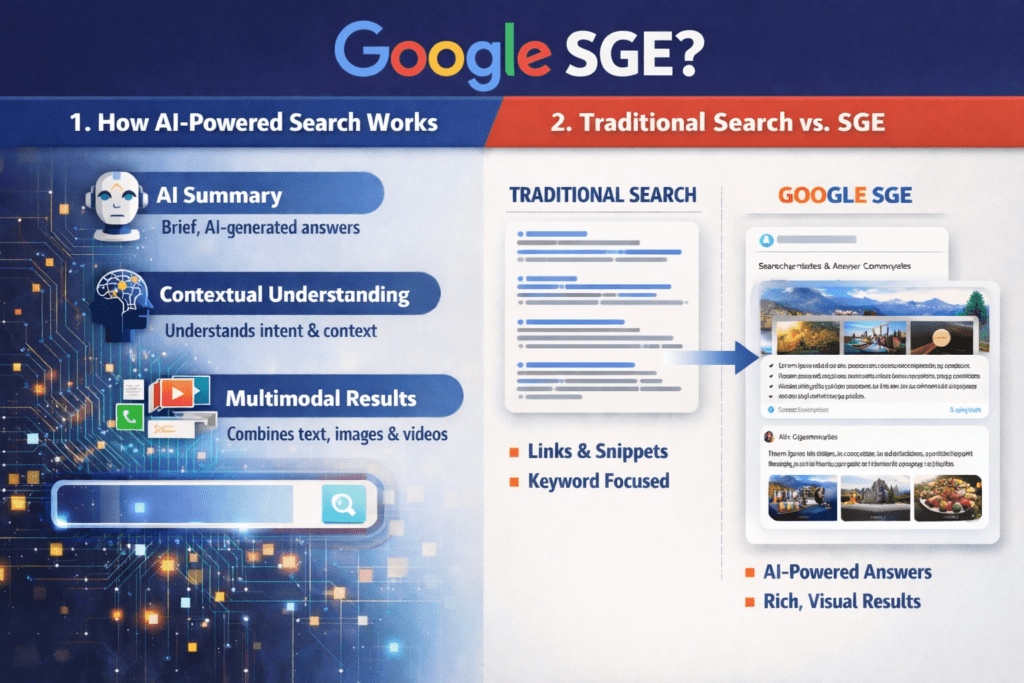
Google SGE (Search Generative Experience) is the next-level search functionality powered by AI, which employs generative artificial intelligence to deliver direct, detailed answers right from the outset of the searched results. While traditionally only the blue links would be visible,
As per SEO, it is very helpful for search engines if the keyword “Google SGE” is put right in the first line of the text because then they (search engines) understand the topic relevance completely. SGE is about making the search faster, more like a conversation, and also more tailored to the individual.
This transition alters the manner in which users interact with the search results and the way websites obtain visibility. From an AIOSEO perspective, such clarifications help in better matching of the search intent and topical relevance and gaining reader trust.
A. How AI-Powered Search Works
Integrating machine learning, natural language processing (NLP), and large data models, AI-powered search is able to figure out what a user wants and provide intelligent responses. Rather than just looking for keywords, AI tries to understand the meaning of the question and gives the answers which are aware of the context.
Google SGE takes information from several reliable web sources, passes it through AI models, and gives a brief answer right on the results page. It keeps learning from user behaviour, feedback, technical but still simple explanations like this help to increase the content’s authority, which AIOSEO is strongly advising.
B. Difference Between Traditional Search and SGE
The fundamental distinction between regular search and Google SGE is essentially about the way answers are given. While traditional search displays a list of links in the order of their ranks, SGE offers AI-generated answers at the top, with the references supporting them below.
In a conventional search, the users have to open several links to get the required information. Whereas in SGE, the users are given a summarised answer straight away, and the links for further reading are optional. Such a transition lowers the number of clicks for certain queries, but, is great for user engagement, getting featured in snippets, and deepening the topic, just as AIOSEO advises.
2. Shift From Keywords to User Intent
Keywords were the main focus of traditional SEO in terms of rankings. AI-powered search has radically changed the landscape in such a way that exact keywords are no longer the main point of focus but rather the real user intent. To put it simply, search engines are now trying to find out what the user really wants instead of just matching the words typed.
AI takes into account context, behaviour, location, previous searches, and semantic meaning to deliver the best possible answers. content that truly helps users is getting higher rankings than those that are stuffed with keywords. From the perspective of SEO, and clarity even more significant than before – which is exactly what AIOSEO proposes for sustainable rankings.
A. Rise of Zero-Click Searches
With featured snippets, knowledge panels, and AI-generated answers in SGE, zero-click searches are rising rapidly. While this reduces clicks for basic queries, competition for SERP visibility is growing. Well-structured ,and credible content is essential, snippet optimization, and authority content more important than ever.
B. Impact on Organic Traffic and Rankings
AI-powered search is changing how organic traffic and rankings work. Search engines now favor helpful, expert, and user-focused content over simple keyword use. Websites that clearly answer questions and show expertise gain better visibility in AI results and attract more targeted traffic.
3. Writing AI-Friendly and Human-Friendly Content
To succeed with Google SGE, content must be clear for AI and engaging for humans. Well-structured, factual writing helps AI understanding, while simple language, short paragraphs, and examples improve UX. Avoid keyword stuffing and robotic writing, as they harm rankings instead of improving them.
A. Answer-Based Content Strategy
An answer-based content strategy is now essential. It involves giving a clear, direct answer at the start, followed by details and examples. This structure helps SGE extract concise AI responses, improving chances of appearing in featured snippets, AI snapshots, and zero-click results through clarity-first SEO.
B. Long-Form vs Short-Form Content in AI Search
In the age of AI search, both short-form and long-form content play key roles. Short-form content delivers quick answers and handles micro-queries, while long-form content builds topical authority, trust, and deep expertise, which AI systems like SGE rely on for credible results.
Google SGE prefers summarizing content from authoritative long-form sources rather than short articles. Detailed content allows deeper topic coverage, internal links, FAQs, and real examples, building AI trust. From an SEO view, well-structured long-form content supports lasting visibility in AI-driven SERPs.
4. Keyword Strategy in the AI Search Era
In AI-driven search, keyword use is evolving. Marketers must focus on search intent and context, not just keywords. AI systems like Google SGE rank content that naturally answers user queries, using semantic relevance and related concepts to deliver the most suitable results.
A. Topical Authority vs Single Keywords
Building topical authority now matters more than targeting single keywords. AI search favors sites that cover subjects in depth and show expertise. Creating content clusters around a core topic signals authority, improving visibility and increasing chances of appearing in AI-generated search results.
B. Long-Tail & Conversational Keywords
Long-tail keywords reflect specific, intent-driven searches and face less competition. In the AI era, users search in natural, conversational language. Using long-tail phrases helps content match these queries, increasing chances of appearing in AI-generated answers while supporting semantic SEO and topic depth.
5. Content Depth vs Content Length in SGE
In the era of Google SGE (Search Generative Experience), content success is no longer about writing longer articles—it’s about delivering deeper value. Google’s AI prioritizes content that fully answers user intent with clarity, context, and usefulness. Understanding the balance between content depth and content length is essential for visibility in SGE-driven search results.
A. Why Depth Matters More Than Length
Google SGE focuses on understanding and summarizing the best answers for users. Content depth means covering a topic comprehensively, addressing related questions, explaining concepts clearly, and providing actionable insights. Even shorter content can perform well if it is precise, well-structured, and genuinely helpful. Depth builds topical authority, which SGE values more than word count.
B. When Longer Content Works
Long-form content still has value when it adds meaningful information. Detailed guides, step-by-step tutorials, and expert analysis help AI systems extract accurate answers. In SGE, longer content works best when it is well-organized with clear headings, concise sections, and direct answers—avoiding fluff or repetition.
C. Optimizing for SGE Balance
To rank in SGE, focus on intent-driven depth rather than stretching content length unnecessarily. Answer core questions early, support them with relevant details, and use clean structure for easy AI understanding. High-quality, in-depth content—whether short or long—has a better chance of being featured in AI-generated search results.
6. Role of Entities and Semantic Relationships in AI SEO
In AI-driven search environments like Google SGE, SEO has moved beyond keywords to a deeper understanding of meaning. Search engines now rely heavily on entities and semantic relationships to interpret content accurately and deliver precise answers. Understanding how these concepts work is essential for modern AI SEO success.
A.What Are Entities in AI SEO?
Entities are clearly defined people, places, brands, concepts, or objects that search engines can uniquely identify and understand. For example, “Google,” “SEO,” or “Digital Marketing” are entities with specific meanings and attributes. AI-powered search systems use entities to reduce ambiguity and ensure they deliver the most relevant information to users.
B. How Semantic Relationships Improve Understanding
Semantic relationships explain how entities are connected to each other. AI search engines analyze these relationships to understand context, intent, and relevance. For instance, linking entities like “SEO,” “content marketing,” “Google SGE,” and “user intent” helps AI understand the broader topic and how concepts interact. Strong semantic connections improve content clarity and authority.
C. Why Entities Matter More Than Keywords
Traditional SEO focused on keyword repetition, but AI SEO prioritizes meaning over exact phrases. Using entities naturally within content helps search engines understand what your page is truly about. When content clearly defines concepts and connects related ideas, AI systems are more likely to trust and feature it in generative search results.
D. Optimizing Content Using Entities and Semantics
To optimize for AI SEO, focus on explaining topics thoroughly, using related terms, synonyms, and contextual references. Structure content clearly with headings, definitions, and examples. This approach strengthens entity recognition and semantic depth, making your content more discoverable and valuable in AI-powered search experiences.
7. How SGE Interprets Questions and Follow-Up Queries
Google’s Search Generative Experience (SGE) is designed to understand not just individual questions, but the entire conversation behind a search. Unlike traditional search, SGE uses AI to interpret intent, context, and meaning across multiple queries, delivering more accurate and connected answers.
A. Understanding User Intent Behind Questions
SGE focuses heavily on user intent, not just keywords. When a user asks a question, SGE analyzes what they actually want to know—whether it’s informational, comparative, or action-oriented. It looks at wording, entities, and context to generate answers that directly address the core need, rather than listing multiple links.
B. Context Awareness in Follow-Up Queries
One of SGE’s biggest strengths is its ability to remember context. When users ask follow-up questions, SGE does not treat them as separate searches. Instead, it connects them to the original query and refines the response. This conversational understanding allows SGE to provide deeper, more relevant answers without users needing to repeat details.
C. How AI Connects Related Concepts
SGE uses entities and semantic relationships to connect related topics across questions. If a follow-up query references “this,” “that,” or a related concept, SGE understands what the user is referring to. This enables AI to expand, clarify, or narrow down answers based on the evolving conversation.
D. Optimizing Content for SGE Question Interpretation
To perform well in SGE, content should answer questions clearly and logically. Use direct answers, subheadings, FAQs, and conversational language. Address related questions within the same topic to support follow-up queries. Well-structured, intent-focused content helps SGE recognize relevance and include your page in AI-generated responses.
8. How SGE Interprets Questions and Follow-Up Queries
Google’s Search Generative Experience (SGE) is built to understand search as a conversation, not a single action. Instead of treating each query in isolation, SGE uses AI to analyze intent, context, and meaning across questions and follow-ups to deliver more accurate, connected answers.
A. Understanding Search Intent Beyond Keywords
SGE focuses on what users truly want to know, not just the words they type. It evaluates intent, entities, and semantic relationships to understand whether a query is informational, exploratory, or decision-driven. This allows SGE to generate direct, helpful responses rather than relying only on keyword-matched pages.
B. Context Retention in Follow-Up Queries
A key strength of SGE is its ability to remember previous questions. When users ask follow-up queries, SGE connects them to the original search without requiring repetition. This contextual understanding helps refine answers, add depth, or narrow results based on the evolving user intent.
C. AI-Driven Interpretation of Conversational Language
SGE understands natural, conversational phrasing such as “what about,” “is it better,” or “how does this work.” It recognizes references and pronouns, linking them back to earlier topics. This enables more human-like interactions and more precise answers.
D
. How SGE Expands and Refines Answers
With each follow-up query, SGE uses semantic analysis to expand or adjust its response. It may compare options, explain implications, or provide next-step guidance. Content that anticipates related questions and answers them clearly is more likely to be used in SGE responses.
Learn Digital Marketing from GICT and Supercharge your growth
Conclusion
An effective keyword strategy in the AI era goes beyond single phrases. Success comes from topical authority, long-tail and conversational keywords, and intent-focused content. By prioritizing semantic relevance and deep coverage, content gains trust, visibility, and stronger placement in AI-generated search results.